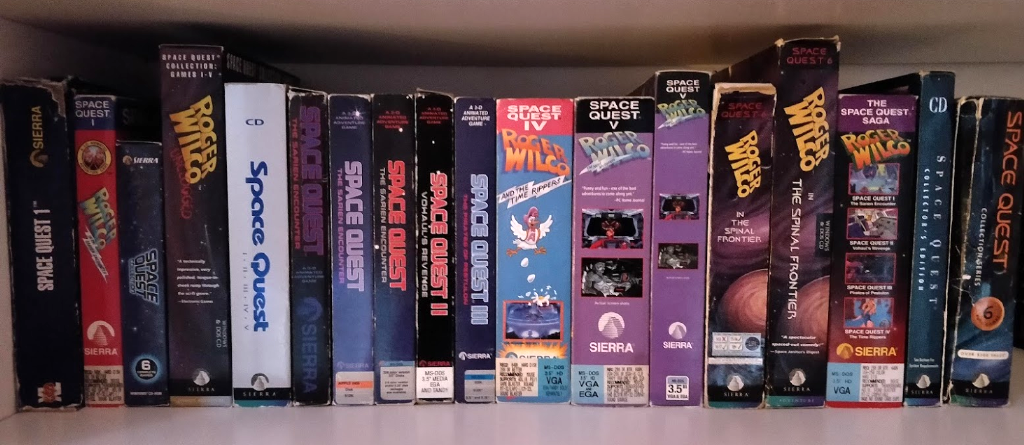
Matt Wales has written for Kotaku a piece entitled “Point and Click is Dead Again,” and that sound you just heard was the collective adventure gaming community all around the world sighing in exasperation. The… More
How to quickly make a Sierra/LucasArts-style game in Adventure Game Studio
AdventureJam 2017 is upon us next week! This means that adventure game developers from all around the world — the good, the bad, the smelly, and the first-time curious — will have two weeks to create an adventure game from scratch.
The beauty of the AdventureJam is that no one expects perfection. It’s just what you can knock out in two weeks. There is a ton of fun to be had with that kind of time constraint. It often forces you to go to silly places, to experiment, and to just do something for the hell of it.
I know a lot of people who say they want to make adventure games, but have no idea how. Back in August of last year, I made a series of tutorial videos that took you through the basics. They were a bit rambly and long-winded, though.
So, in anticipation of this year’s AdventureJam, I have made two new tutorial videos that are a lot more snappy — aimed at getting you started quickly.
The first one is about how to make a Sierra/LucasArts style adventure game with on-screen characters:
Continue reading “How to quickly make a Sierra/LucasArts-style game in Adventure Game Studio”
“The nostalgia is starting to pixelate.” – Review of Thimbleweed Park
Well, of course I played Thimbleweed Park. It’s probably the most anticipated adventure game to come out since Double Fine’s Broken Age. It made a lot of promises, none of which seemed unreasonable, while managing to keep the actual story and mystery a secret right up until its launch.
With a name like Ron Gilbert at the helm — even most gamers who don’t give a shit about adventure games know what Monkey Island is — expectations were, unsurprisingly, high. Here are my thoughts on whether these expectations were warranted, and if the game lives up to them.
Whether or not I liked the game, though, is only a small part of this review. There is a deeper discussion about the game’s design (particularly the multi-protagonist design) and the story itself that I think warrants some exploration.

Continue reading ““The nostalgia is starting to pixelate.” – Review of Thimbleweed Park”
Do Let’s Players hurt sales of adventure/narrative-driven games?
I got into an interesting discussion on Twitter last night — which, frankly, I probably should have been more awake for.

The debate was about how developer Atlus have effectively told Let’s Players not to play their game (at least, not any more than the beginning of the game).
The official explanation is that it’s a story-based game and Atlus doesn’t want the story spoiled for people who haven’t had a chance to play it themselves. A cynic like myself, however, might entertain the notion that it’s also an attempt to prevent people from just sitting down and watching a playthrough on YouTube or Twitch instead of going out and actually buying their own copy.

The question then becomes: do streamers or YouTubers who play games from start-to-finish — particularly games that rely heavily on an unfolding narrative, like adventure games — hurt sales of those games?
Continue reading “Do Let’s Players hurt sales of adventure/narrative-driven games?”
The importance of good world building – or, how Resident Evil 7 won me over
Not so long ago, I watched some Let’s Plays of Resident Evil 7, and wanted to write about being surprised that, for the first time in my life, I found myself actually giving a shit about a Resident Evil game. I’ve also watched the DLC stuff — in fact, recently, I watched some of the second DLC package, in particular the “Daughters” segment.

Now I feel like I have a handle on what I actually want to talk about, which is what made me suddenly give a shit about Resident Evil. It’s not just the masterfully creepy suspense that I think almost everyone agrees is done to damn near perfection. It’s also the keen sense of world-building and history that went into crafting the story.
Because, on the surface, Resident Evil 7 sounds like any survival horror game: you’re trapped in a confined location, monsters are out to get you, and you have to survive while the game does everything in its power to dick you over. Monsters will jump out when you least expect it; you’re always running out of space in your inventory; you’ve never got enough bullets in your gun to take down even the puniest of enemies.
Even story-wise, at least on paper, it sounds kind of hokey. A rural family in Louisiana has gone batshit insane, apparently taking your wife hostage, and your first instinct is to just go in there after her, instead of doing something sensible, like call the police or, at the very least, bring a fucking gun.

There’s more going on here than what’s just at the surface, though. So I want to dive into that for a bit, but first:
Huge, dinosauric spoiler warning. If you haven’t played Resident Evil 7 yourself, and you intend to at some point in your life, you might want to find something else to read.
Continue reading “The importance of good world building – or, how Resident Evil 7 won me over”